DEBUG

Life After Twitter

Never did I think that 140-character messages could have addictive qualities, much less, teach us a lesson or two about life itself. #neversaynever

*

I broke up with Twitter just over a year ago—on January 8, 2010.

I use the phrase "broke up" literally. After all, my departure came complete with a ‘Dear John' letter titled, Dear Twitter. By posting this publicly I'd finally committed to ending a tumultuous relationship. And boy, did I. I quit cold turkey and have stayed clean since then.

So, let's get right to the $64,000 question—Was it worth it?

As with most answers to $64,000 questions, a simple "yes" or "no" answer won't suffice (it's a "yes", by the way). The interesting part isn't the answer itself, but, as they say, the journey.

Twitaholics Anonymous

There exists considerable and justifiable concern today about Twitter's resemblance to a drug.

Indeed, Twitter addiction is a serious and growing problem that's even making cameos in Hollywood. And, it's a particularly elusive addiction in that there are no obvious symptoms or side-effects. Like say, abusing Twitter generally doesn't provoke one to discuss philosophy with a cat. Or worse, do things like this—

To make matters worse, diagnosing a Twitter addiction is one big hit-or-miss charade. What does it mean to be "addicted"? If you can stay off Twitter for a day, does that mean you're not an addict? Or is it a week? What if you just peruse, but never send tweets?

My hindsight indicates that trying to determine addiction criteria is a waste of time. Each individual has a unique motivation guiding his or her Twitter usage, and the physical manifestation of the addiction varies significantly as well. Scoble tweets tens of times an hour, for instance, but that doesn't mean he's addicted (I'll argue later that he may be quite the opposite of addicted). On the flipside, I'd reduced my tweeting frequency to one per day towards the end, and I still felt horribly shackled.

The clue to figuring out what it means to be addicted to Twitter comes from a celebrated yet unexpected book—yes, life after Twitter indeed includes all sorts of crazy things like books!—written two decades ago by a Hungarian psychology professor, Mihaly Csikszentmihalyi.

Titled "Flow: The Psychology of Optimal Experience", Mihaly shares in his book the secret to happiness, a concept he calls, you guessed it, flow.

Conscious Flow

So, what is flow?

In Mihaly's own words from a Wired Magazine interview, "Being completely involved in an activity for its own sake. The ego falls away. Time flies. Every action, movement, and thought follows inevitably from the previous one, like playing jazz. Your whole being is involved, and you're using your skills to the utmost." Anyone who has pursued a hobby all their life—like playing the guitar, running, writing, cooking, solving puzzles, even reading—should find it pretty easy to relate to this.

According to Mihaly's research, the key aspect to achieving flow is our ability to control our consciousness and immerse it activities that are autotelic, i.e. activities that are self-contained and done without the expectation of some future benefit, but simply because the doing itself is the reward.

The common motivation behind using Twitter, however, is exotelic, i.e. extrinsically motivated. On Twitter, we seek validation, role-play, try to score followers, indulge in lekking, promote ourselves and our work, promote others in hopes that they'll promote us, and indulge name-your-favorite-exotelic-motive. This is not to say that any of these motives couldn't manifest autotelically—take Scoble who turned the activity of growing a follower count into an endurance sport; Mihaly interviewed many long-distance athletes and found them to be in a high flow league—but few of us have succeeded at making them autotelic.

Flow
Flow is one of the best books ever written on happiness.

It's not just that we engage exotelically, but the inevitable infinite loop of it all that's most worrisome. Twitter has the ability to gain control of our consciousness. That is, Twitter diminishes our attention span drastically. The more we are on it, the more we seem to want it. When we're away from it, we spend our time thinking about it. And, the evidence echoes in the familiar gripes of countless Twitter users who describe their social media involvement with terms usually reserved for codependent love affairs.

But, it's unclear whether overuse of Twitter has any lasting physical or mental effects; we certainly haven't gotten to the point that WoW gamers did a few years ago. But as most people who speak of Twitter as an infatuation already suspect, the price of the habit is opportunity cost. Twitter may not make you do crazy things, but it may make you stop doing many things.

There's nothing like a year's worth of experiences to confirm this suspicion.
The Proof is in the Pudding

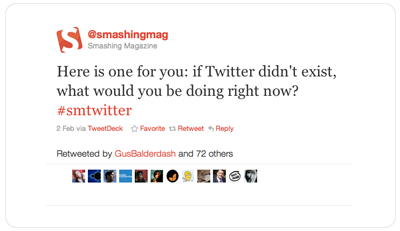
What would you be doing if you weren't on Twitter?
A timely tweet by Smashing Magazine a few weeks ago.

I made a quick list of things I did in 2010 that I felt went above and beyond prior years. They may not be big to others, but they were significant for me. Bear with me as this list is a means to an end.

I designed and launched a personal blog, started training for and competing in triathlons (ironically, this was before I read Flow and its findings about endurance athletes), launched a small company/side-project with my wife, wrote around 15 articles, and read around thirty books (the sum total for the two years before it was, embarrassingly, two books). This was in addition to doing really well at my job, which is a time commitment in and unto itself.
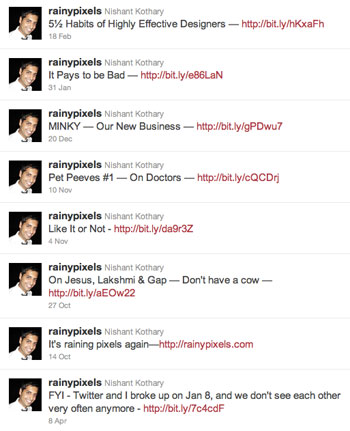
My tweets over the last year
I reduced Twitter to RSS in 2010

It's also worth noting that 2010 was also a particularly relaxing and stress-free year for me. I took two vacations (a total of three weeks), hosted family at my house for around eight weeks (this is borderline insane, and I don't recommend it), started taking ski-lessons, and even watched all the seasons of Prison Break and 24 on Netflix. OK, the last one wasn't exactly relaxing or a healthy substitute for Twitter because we were addicted to both shows and watched them in marathon fashion till our brains went numb (the astute among you notice a trend here—I have a propensity to surrender my consciousness to mindless entertainment).

All of these activities share one thing in common—they require focusing one's attention for long periods of time—something I couldn't dream of doing in my Twitter days because, well, I had the attention span of an oyster.

Admittedly, correlation is not causation, and my higher productivity levels likely have to do with many other factors—hormonal changes, better financial stability, exercise-induced endorphins, excessive Weimaraner petting, and so on. But correlation is correlation, and I've found a strong, almost causation-like relationship between quitting Twitter on one side and higher productivity levels and stronger personal relationships on the other.

#TheVerdict

So, we're clearly concluding that quitting Twitter can be a very good thing. But that's not the $64,000 question anymore, is it?

There's a much bigger question on our minds—a natural, deeper, even philosophical, question.

Is Twitter bad?

It turns out that we can convincingly argue both sides on this one. And, we have—Packer and Carr are just one example of the case in point. Depending on which way we swing, we tend to pick one or the other. And then a very elegant human imperfection, confirmation bias, steps in to fortify our choice. We are wired to pick and then protect our binary choices—red or blue—so much so that it's the foundation for everything from our computers to our political process.

In a broad sense, this question we're trying to answer is not as much about Twitter as it is about the paradox that is life itself. It's a dilemma that has vexed us through the ages as evidenced by the old saying, "One man's meat is another man's poison." But if my recent experience reinforced anything, it's that the answer to such trick questions often lies somewhere on the spectrum between red and blue. The real answer is a shade of purple, which coincidentally, is the color of introspection.

So if we must have an answer to the question whether Twitter is bad, then let it be this—you must find the shade that helps you achieve flow. One where you're in control, not Twitter.

As for me, it seems I'm ready to give Twitter a second chance myself a second chance with Twitter.

*

29 Comments

Corey Myers

I would just like to say that I would not have read this article if not for twitter. My mind is lost in the irony of it.

Kyle

Interesting. I think its important to be aware of ourselves and our habits/ego with these things, but as you say in the end, this is more about ourselves than Twitter.

Twitter is more the stage for this conversation but the message is relatable enough to Facebook and Forum Communities as I see it.

Tom

How do I retweet this? LOL

Stephanie B.

I love Twitter.

I’m an artist, but I tremble at the thought of striking up a conversation with a stranger, even though part of the reason I moved to Portland was to take advantage of the community of artists that this city has to offer. Twitter makes it much easier to approach other artists, to express my admiration, to ask a question, or to share my excitement over a new discovery.

For the first time in a long time, I feel like I’m part of a community, and the virtual community has encouraged me to get out and explore my actual community as well.

I love Twitter, but I can still flow. I still tend to get lost in a painting, to the point where I lose track of time – and I can still sit down to watch old episodes of Moonlighting for hours on end!

Matt Bramer

So instead of tweeting on Twitter, you blog about Twitter? What’s your hidden handle that you tweet under anon? I’m sure you have one. C’mon, stand up and admit it…

Nishant

Corey/Tom — :-)

Kyle — Yep. My Facebook habit changed quite a bit as a result of the Twit hiatus.

Stephanie — Really good point and makes me remember ICQ for some reason. I always thought it was so much easier to be bolder on IM than in person. Seems like you are/were differentiated enough to not be lured into Twitter snorting. And, Moonlighting! I totally forgot about that show. Ah, Bruce Willis with hair… those were the days.

Matt — Ya got me.

Luis Merino

Incredible article, I loved it.

I have a question, if reading makes you go in the “flow”, would reading this book “flow”, make you enter the double “flow”?

Cheers.

Brennan Clarke

As already mentioned above I too found thing article via Twitter which I just signed up for last night.

Maybe this is simply nieve of me to think, but I’d say my reasons to do this are for myself only. I don’t care about followers or who reads what I write; I write simply because I feel compelled to journal these things. Even if I don’t read them again, it’s just like talking to your cat, I guess. Just an impassive friend to reflect with and note your observations to.

But! Am I the kid who starts drugs with all these well intentioned justifications only to find himself in court-ordered rehab months or years later? Is the above ridiculous for me to think?

Either way I think I’ll have to pick up that book…

Nishant

Luis — I did. You should find out for yourself. ;)

Brennan — That’s how it starts. And for some, it stays that way. For others, they become monkeys hitting the big red (refresh) button. It’ll be an interesting behavioral experiment, though. Now that you know about this, maybe you’ll be immune… maybe it’ll function like a vaccine. And yes, get the book.

Neil Hawke

Strangely, and unlike others here I was emailed this link, not found via Twitter. Strangely number 2, this week Twitter and I are “on a break” too. And yes, I have more than a passing allure for the medium…

Really fascinating article and one that I can readily relate too. I am thankful though that some of my digital friends have become very real friends, much to derision of my older real friends (“it will never work out” syndrome).

I am assessing my relationship with Twitter anyway. Perhaps a longer term break will help. Perhaps not. But it is true that when you’re on there you miss it, and wonder if it and your “friends” miss you. Maybe that’s just me. Addicted? Yeah, probably.

But one thing for sure Nishant, I will buy that book. So for that at least, thanks!

pineapple

please, twitter isn’t even remotely as addictive (and potentially destructive) as facebook!!! put the same energy into a diatribe against facebook and actually SAVE SOME LIVES! i quit facebook years ago. still on twitter and i feel wayyyyyy better!

Nishant

Neil — It’s interesting that Twitter turned into a source for new real-life friends for you. “It’ll never work out” syndrome — Ha! Yeah, my experience was slightly different… I wasn’t worried about how many of my “friends” missed me, but relinquished conscious control over other factors like watching follower count, retweets, and @ replies, and so on. Good luck with the break… let me know how it works out. And, yes, enjoy the book.

Pineapple — Just swap “Twitter” out with “Facebook” in the article and you’ve got your wish (mostly). Unfortunately, I can’t relate as much… my Facebook is filled with people I know in real life, and my interactions on there are generally pretty real as compared to those on Twitter. I can totally see what you mean, though — wanting to hit refresh to check statuses, perusing photos, spying on profiles of friends, and so on.

Adam Kinney

Nice article, Nishant.

Since making my recent career shift, Twitter and Facebook have become casualties in my efforts to achieve said Flow. Its still great to connect with people and share information, but I no longer work with a twitter client open. Instead I usually browse on my phone when I have a long second somewhere and then email links to myself to read later. That’s how I came back to your article.

Now, I’m much more concerned with creating and experimenting and that’s hard to do when you’re talking all the time.

Nishant

Adam — That’s exactly my MO now, too. I made my “Twitter comeback” last week, but it’s tough to teach an old dog new tricks, I guess. I tweeted a few times, but it seems that my comeback will be characterized by perusing in the long second, as you call it, emailing links/favoriting tweets, and replying to messages. I suppose it’s too early to tell if this’ll change, but right now I am finding it unnatural to tweet proactively. See you at MIX, dude. :-)

Jacob Cummings

More than putting a focus on twitter and letting it go, I think you are reflecting on what was necessary for you to let go of in order to move forward on life. What resulted in 2010 was possibly less intentional and more of an uncharted territory, and a natural transition into your next temperament.

For me, twitter has served as a means to let go, to indulge in expressing myself when desired and with the intention that I’m doing it for myself without much regard to who may be judging me. The experience has been necessary to my flow. Similarly, very consiously Yelping and checking in, reviewing places and reflecting is serving a positive purpose that hasn’t quite revealed itself to me.

A flow inhibitor for me, simply, is not my smartphone or the media sources that I indulge in. The answer is more in my lack of self control or conscious awareness of what is lost or disrupted because of misuse.

Finally, while reading this article, I thought about all the time everyday that I have a screen in my face, and wondered what might I be doing otherwise?

Dr. Hook

I thought cold turkey meant no tweets at all.

Juliette

You’re right, twitter let’s us know who we really are….a unique combination of seeker and follower, of proud follower-getters and philosophic or otherwise smart trompeters or just plain ordinary spammers.

I like to look at it this way: What makes twitter worth spending time on is when something resonates with me, as your article did. Nicely written.
And if something resonates with others when I send out a tweet, that as well contributes to the flow.

Anyhow, yes definitely, tweeting should be a part of living in flow motion.

Amy Spreeman

Great article! About a month ago, I had to quit Foursquare. I was completely, helplessly addicted to it. (My mayoraliships are still up for grabs, and I admit that once in a while I do check to see where my friends checked in.)

So yes, I had a problem with Foursquare and I took care of it. But Twitter? I don’t have a problem with Twitter. I can give it up anytime I want to. Really.

Amy Spreeman

P.S. I just followed you on Twitter!

CWebba1

The ego-driven reasons that you provide for using Twitter make me feel sad. Perhaps you never learned how to use Twitter properly, so of course your results were faulty. My context is that Twitter is mostly about listening. I learn about everything when I read other people’s Twitter URLs. Yes I make comments, but mostly I re-tweet great information by other people, and download tons of great knowledge. I am so thankful for twitter. I just hope that they keep the interface simple and robust, and resist the temptation to “monitize” it. <– This is the true addiction in social media, me thinks.

rainypixels

Jacob — Thanks for sharing that. Seems like your social media indulgence is and has always been autotelic. You are one of the rare ones.

Dr. Hook — I hope that’s your real name (because that would be awesome). I allowed myself one tweet in April because I was still getting @ replies; I’d packed up and gone home without as much informing some of my friends on twitter. I even updated my profile when I sent out that tweet with a link to “Dear Twitter”. As for the remaining tweets, all published through WordPress. This may seem like a double-standard, but remember, the premise of my post isn’t at all that Twitter is bad. In fact, I still think it’s the best way to get the word out in many contexts. As for the recent tweets, well, I’m back on Twitter. So far, so good. :)

Juliette — Agreed. And, “flow motion”… love it!

Amy — To each her own vice. ;) See you on Twitter.

Nishant

CWEBBA1 — Again, always great to know that people like you exist. I rarely meet folks who use Twitter autotelically like you. Maybe someone needs to put together a cheatsheet of do’s and don’ts for twitter. :) But that would defeat the purpose now, won’t it? There is no “right” way to use Twitter and there’s nothing inherently right or wrong about Twitter itself.

As for capitalism, for another post, another day… :)

Zach Schneider

@mixn great article, and that video was disgusting but fitting. Twitter isn’t good or bad but it can be both depending on how the user goes about using or abusing it.

[...] que eu estou perdendo?”, etc.E daí o cara passou todo o ano de 2010 longe do Twitter. No texto ele conta que fez milhões de coisas incríveis (todas elas requeriam total foco, coisa que ele [...]

Vica

Why are people from India/from Indian background so good looking?
It’s interesting coz I’ve heard about this book years ago, and at the time I thought it was complete bullshit. But since I haven’t read it, maybe I’ll give it a chance.
I tweet a lot (I have 2 twitter accounts). But last year I read 25 books, so I guess twitter was not preventing you from reading.
Anyway, interesting point of view.

fractalfrog

You remember those old Miller Lite commercials: “tastes great” vs “less filling”?
I have a similar dilemma with Twitter but in my case it is: “pointless” vs “useless”. :P

Nishant

Vica — The book is definitely not BS. :)

Fractalfrog — I’m still on the fence. I suspect a decade from now we’ll find that Twitter was a step towards __________ (where __________ is something that will be as obvious in its utility as email is today). So, for now, I’m going to hang out on Twitter so long as it doesn’t get in my way.

[...] Ironically, in practice it seems that creating predictably delightful designs isn't about exerting control. It's about judiciously giving it up. It's about identifying the right fluidity for the process and establishing the optimal flow. [...]

*

Leave a Comment


Nishant

Hi, I’m Nishant. I live near rainy Seattle with my wife, Pita, our two cats, Izzy & Mango, and our notorious Weimaraner, Yoshi.

More about me →
*
Latest Work

I do a variety of things for a living. Most of them have to do with the Web.

Check out my work →